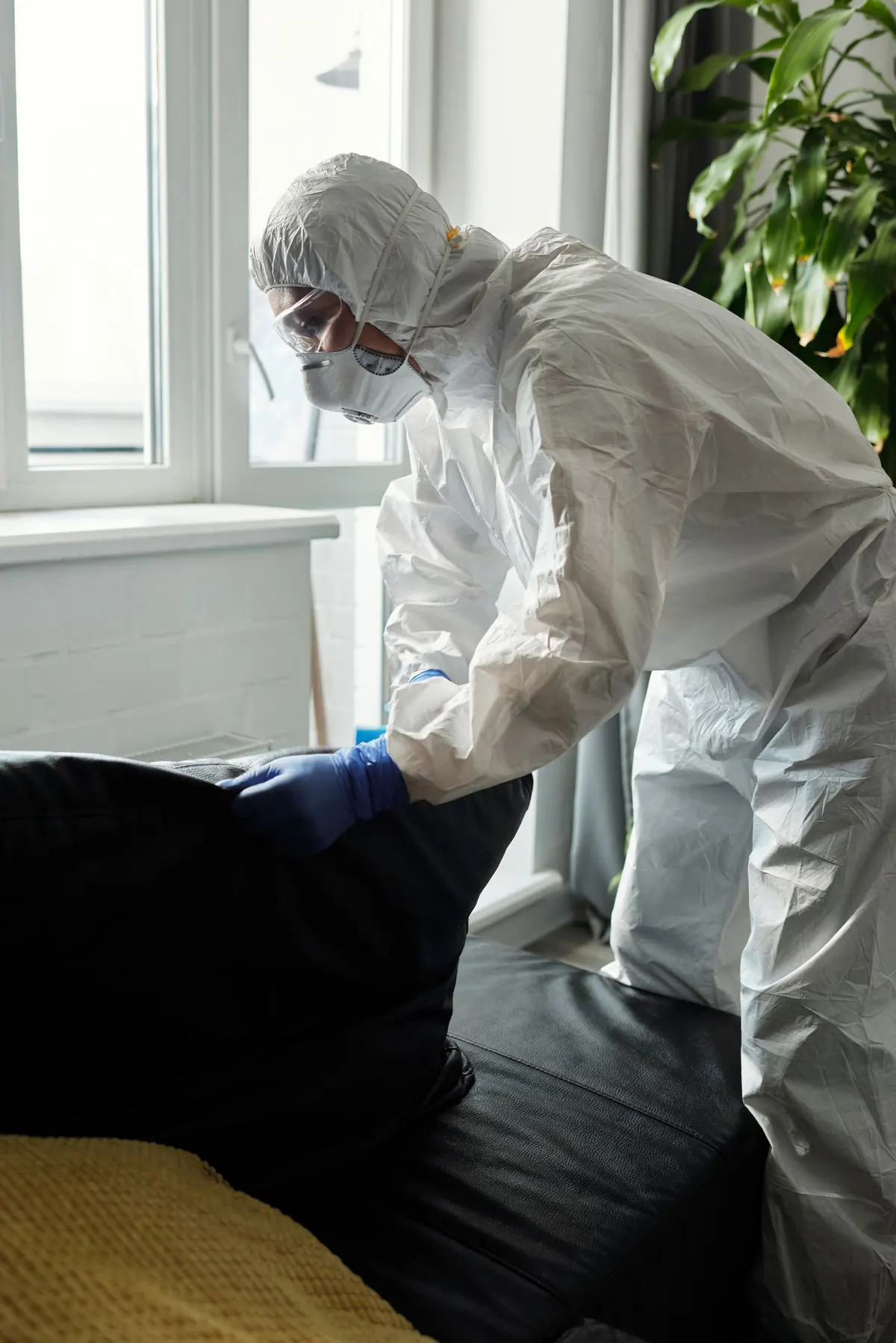
Done to the IICRC S520 standard: contained, removed, HEPA-cleaned, and verified
Need mold remediation in Missouri City, TX? Visible mold, a musty smell, or mold after a leak? We contain it, remove it, fix the moisture source, and verify the result to the IICRC S520 standard. Free on-site inspection, written quote, and insurance documentation across 77459 and 77489.
Call and talk to a certified mold remediation specialist about what you're seeing — and what it will take to fix it for good.
Wiping or painting over mold leaves the cause behind, and it grows back within weeks. Real certified mold remediation in Missouri City, TX follows the IICRC S520 standard: find the moisture source, contain the area so spores don't spread, remove what's contaminated, HEPA-clean, dry the structure, and verify the result before the containment comes down.
REQUEST A QUOTE
Complete the form and describe the work you need help with.

According to the IICRC and CDC, mold starts growing 24 to 48 hours after water intrusion. A slow drip under a sink or a failed toilet seal can seed a wall cavity before you smell it, and waiting turns a one-room job into a structural one.
Damp drywall, wood, and insulation grow mold within two days. After that it has to be remediated, not just dried.
Fort Bend County runs roughly 74% outdoor humidity, so mold returns unless indoor humidity stays at 30–50%.
Many homes dried with household fans after Harvey have residual mold in wall cavities and subfloor that was never fully addressed.
The rooms we are called to most often, each handled with the same S520 sequence.
Ceilings, grout lines, and the wall cavity behind the tile.
Roof decking and rafters wetted by condensation or a leak.
Hidden growth inside wall cavities and under flooring.
Drain pans, air handlers, and sweating supply registers.
Cabinet bases and subfloor soaked by a slow drip.
Joists and subfloor under pier-and-beam homes.
Stachybotrys handled with stricter containment and PPE.
Residual mold left behind after fan-and-shop-vac drying.
Six steps, in the right order, so the mold is gone and stays gone.
We map the affected area with moisture meters and thermal imaging and trace it back to the leak or humidity driving it.
Poly sheeting and HEPA-filtered negative air keep spores out of the rest of your home.
Contaminated porous materials come out, surfaces are HEPA-vacuumed and wiped with antimicrobial, and the air is scrubbed.
We dry the framing and remaining materials back to a normal moisture content so the area can't re-grow mold.
Post-remediation clearance confirms indoor spore levels match or beat the outdoor baseline before containment comes down.
We document the job for your insurance and leave you with the humidity targets that keep mold from returning.
Mold remediation in Missouri City, TX typically runs about $10 to $30 per square foot, and most local residential jobs land between roughly $1,500 and $6,000. Black mold and jobs that need heavy containment sit at the higher end. Three things set the price, and we confirm them on a free on-site inspection before you get a written quote:

We provide mold remediation in Missouri City, TX as a service-area company, covering every neighborhood in 77459 and 77489, from the master-planned communities along Sienna Parkway to the established subdivisions off Cartwright Road. See all the areas we serve in Missouri City.
Confirm Coverage — Call NowTexas mold work is regulated by the TDLR. A licensed Mold Remediation Contractor (MRC) does the work, and on jobs over 25 square feet an independent Mold Assessment Consultant (MAC) handles the assessment and final clearance, so the crew never grades its own work. We coordinate third-party clearance testing, provide the documentation your insurer or a future buyer will ask for, and bill insurance directly where coverage applies.
Many homes in Riverstone, Lake Olympia, and Quail Valley were dried with box fans after Harvey. That clears the visible water but rarely dries wall cavities or subfloor in time, so mold grows behind drywall, under flooring, in attics, and beneath pier-and-beam floors. A musty smell that won’t go away is often the first sign.
Dark, slimy growth on damp drywall or wood may be Stachybotrys chartarum, but color alone can’t confirm it. Scrubbing or bleaching it sends spores into the air. The fix is the same either way: contain it, remove it safely, dry the area, and verify the air, with stricter PPE when black mold is suspected.
Hire a TDLR-licensed contractor who follows IICRC S520, fixes the moisture source, and uses an independent assessor for clearance on jobs over 25 square feet. Get the scope in writing, and be wary of anyone who quotes a firm price sight-unseen or pushes a large tear-out before inspecting. Our certified team works to all of these standards.
Call (816) 371-0136 and describe what you’re seeing. We’ll tell you honestly whether it needs a professional, schedule a free on-site inspection, and give you a written quote, a clear timeline, and documentation for an insurance claim. A contained single room typically takes three to five days; larger or structural jobs can run one to three weeks.
Straight answers to what Missouri City homeowners ask first.
Certified, IICRC S520 remediation with a free quote and clearance documentation. Talk to a specialist now.
(816) 371-0136